
Your Next Customer Might Not Visit Your Website. Their AI Will.
Claude for Chrome, Anthropic's browser extension that reads pages and fills forms, has been rolling out to paid subscribers since mid-2025. What the shopper-side behaviors - automated comparisons, batched form submissions, price monitoring - mean for a dealership site.
Adam founded Savvy Dealer and has spent 30 years at the intersection of automotive retail and digital strategy.
Want to Learn More?
Book a quick demo to see these strategies in action.
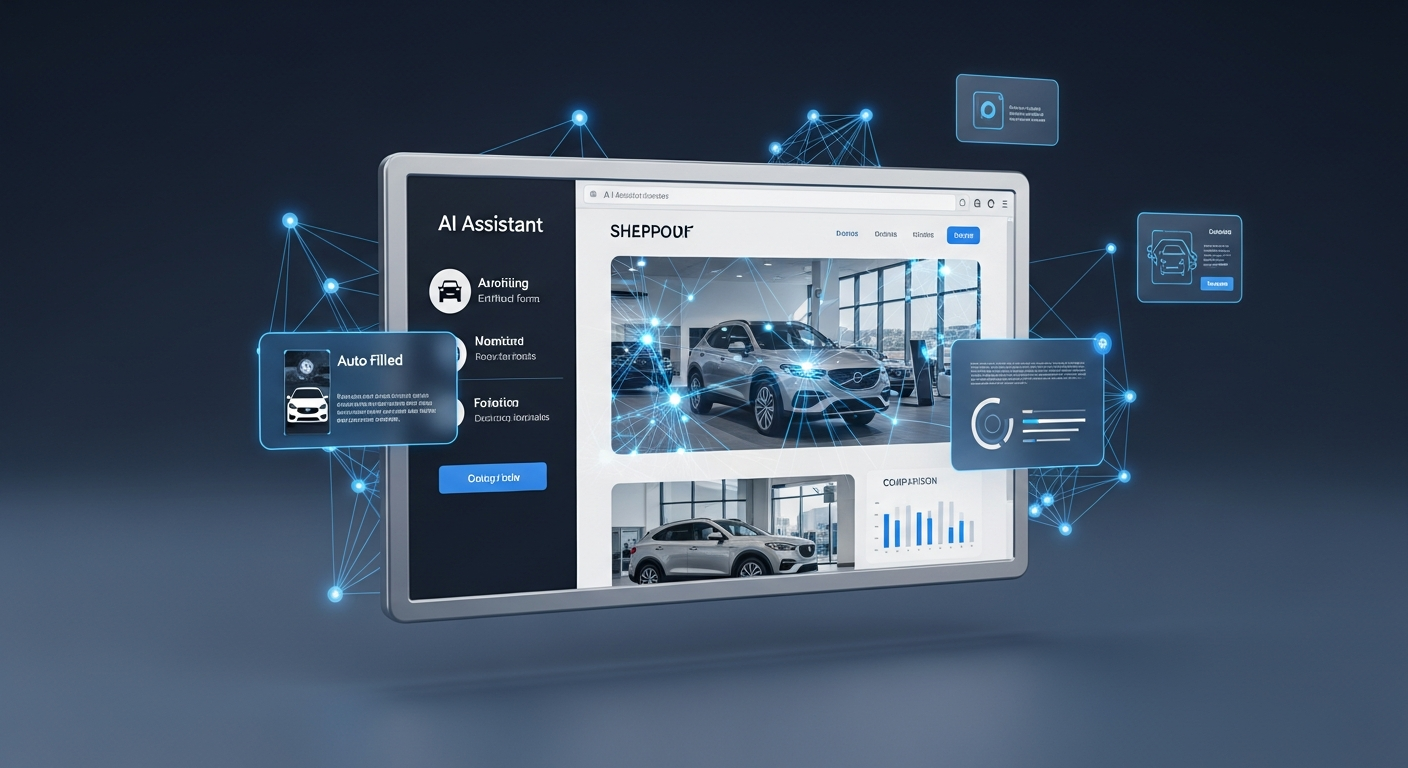
Anthropic's Claude for Chrome, a browser extension that reads pages, fills out forms, and completes multi-step tasks inside the browser, has been rolling out to paid Pro and Max subscribers since mid-2025. By December it is a shipped product, not a preview: a shopper can sit in a sidebar and have it do the browsing.
What Is Claude for Chrome?
Claude for Chrome is a browser extension that embeds AI directly into Google Chrome. Users can ask Claude to browse websites, extract information, fill out forms, and complete tasks, all from a sidebar while they browse.
Think of it as a personal assistant that can see everything happening in your browser and act on your behalf.
Anthropic (the company behind Claude) has been testing it internally for tasks like scheduling meetings, drafting emails, and testing website features. Now they're rolling it out to paying subscribers.
Other companies are racing to do the same thing. Perplexity launched its own AI browser called Comet. OpenAI is reportedly building one too. Google is embedding its Gemini AI deeper into Chrome.
The browser is becoming the new battleground for AI, and dealership websites are directly in the crossfire.
What the Extension Does to a Dealer Site
Three of the shopper-side behaviors matter for a dealership, and they are already in the product:
Cross-dealer comparison. A shopper asks: "Compare the 2024 Honda CR-V inventory at these five dealerships and show me the best price within 50 miles." The extension handles the tab-switching, reading, and summarizing. Pricing strategy effectively has to assume total transparency: a number that only exists after a phone call is no longer a number the shopper sees.
Batched form submissions. The extension can fill inquiry forms, and there is nothing stopping one shopper from having it submit inquiries to ten dealerships in a row. Expect more leads and a lower average intent per lead; lead scoring and follow-up speed are where the difference between those two facts becomes a sale or doesn't.
Price monitoring. Users can set recurring tasks, so an inventory page that checks daily for a specific vehicle is a plausible customer behavior, not a hypothetical.
The flip side of the same tool: a dealer can point it at competitors - pricing, inventory changes, promotions across several sites, on a schedule - which is the same mechanism as a mystery shop that runs itself. And the extension's own test of a dealer's site (speed, whether the content is accurate, whether a form actually submits) is a cheaper audit than most agencies would bill for.
What Should Dealers Do Right Now?
1. Audit your website for AI readability
Is your content structured clearly? Are your VDPs easy to parse? Can an AI quickly extract the key information a shopper needs? If your site is cluttered, slow, or confusing to navigate, it will be just as confusing to an AI agent.
2. Prioritize speed
AI agents will favor sites that load fast and deliver information quickly. If your website takes 5 seconds to load, Claude isn't going to wait around, and neither will the shopper using it.
3. Think beyond SEO
Search engine optimization is still important, but it's no longer enough. You need to consider how your content appears to AI systems like ChatGPT, Perplexity, and now browser-based agents like Claude. This is what we call Generative Engine Optimization (GEO).
4. Prepare for lead volume changes
If AI makes it easier to submit inquiries, you'll likely see more leads, but not necessarily better ones. Your follow-up process and lead scoring need to be ready.
The Bottom Line
Today a customer browses your website. With a browser agent, the browsing can be delegated: the agent summarizes the inventory, compares the prices, and decides which dealership is worth contacting. The site that survives that delegation is the one whose content is structured for extraction - which is the same Generative Engine Optimization (GEO) work as AI search, applied to a page a human will never open.
Want to make sure your website is ready for AI-powered shopping?
At Savvy Dealer, we've been optimizing dealership websites for AI discoverability since before it was mainstream. Our GEO strategies help dealers show up in ChatGPT, Perplexity, and now browser-based AI agents.
Contact us for a free website audit and see how your site performs in the age of AI.
Savvy Dealer is a digital marketing company serving automotive dealerships. We specialize in AI-optimized websites, GEO, PPC, and transparent reporting.
Get Our Answers in Your Google Results
Add Savvy Dealer as a preferred source and Google highlights our articles with a Preferred badge in AI Overviews, AI Mode, and Top Stories. One click, then check the box next to savvydealer.com.
Ready to Transform Your Dealership's Marketing?
Schedule a free demo to see how Savvy Dealer can help you sell more cars.