
Good FSD or Janky FSD: Appraising a Used Tesla for a Trade or Auction Buy
A used Tesla's self-driving is locked to the hardware in it, and you can't upgrade it after the fact. Before you write a trade offer or place an auction bid, here's the one-year rule that separates the cars with the good FSD from the ones that never get it, and the five-minute check that settles any borderline unit.
Adam founded Savvy Dealer and has spent 30 years at the intersection of automotive retail and digital strategy.
Want to Learn More?
Book a quick demo to see these strategies in action.
You've got a Tesla coming in as a trade, or one on the auction block, and you're about to write a number. Before you do, there's one question that's worth more than the mileage, the paint condition, or the owner count: does this car run the good FSD, or the janky FSD?
The reason it matters to you specifically is that FSD is software, but it's locked to the computer hardware sitting in the car. You cannot retrofit newer hardware into an older car. The hardware is a permanent ceiling on how good that car's self-driving ever gets, and it decides how much of the FSD a future buyer can actually use. Get it wrong at acquisition and you end up one of two ways: you overpay for a car whose self-driving story is already over, or you mis-price it on the lot and sit on it longer than the numbers support.
This guide is for the two moments where that hardware question actually costs or makes you money: appraising a trade-in and bidding at auction. Here's the one-year rule, the hardware generations in plain English, and the five-minute check that settles any car on the edge.
The one-year rule
Treat a Tesla built in 2019 or later as a different animal from anything 2018 or older.
That single line is the whole framework for most units. Everything from mid-2019 onward runs the modern FSD, and everything before that is on old hardware that can't run the current software the way the new cars do. The only real ambiguity is a 2018 Model 3, and below we'll show you why that means you should handle it differently at the trade window than at the auction — not just skip it.
Why 2019? Because that's when Tesla's hardware generations flipped.
The hardware generations, in plain English
Tesla has shipped four generations of self-driving hardware. Here's where you find each one and what the FSD is actually like.
| Generation | Where you find it | What the FSD is like |
|---|---|---|
| HW1 | 2012–2017 Model S / Model X | No FSD at all. Tesla dropped these years ago. |
| HW2 / HW2.5 | 2016–2019 Model S / Model X; early 2018 Model 3 | "Janky." Old, weak 720p cameras and an outdated chip. Can't run the current FSD the way newer cars do; gets little or no modern FSD. |
| HW3 | 2019–2023 Model 3, Model Y, Model S, Model X | The good FSD. This is the baseline the modern FSD software runs on, and it handles today's updates fine. |
| HW4 | 2023+ refreshed Model S / X, 2024+ Model 3, 2025+ Model Y, all Cybertrucks | The best FSD. More powerful chip plus sharper 8MP cameras, built to carry the next several years of FSD updates. |
So the practical split is clean:
- Pre-2019 → HW1 or HW2/HW2.5 → no FSD or janky FSD. The value gap.
- 2019–2023 → HW3 → the good FSD. The value sweet spot.
- 2024+ (and any Cybertruck) → HW4 → the best FSD. The premium car.
The one edge case: the 2018 Model 3
The only unit that genuinely straddles the line is the 2018 Model 3. Model 3 production started in the fall of 2017, and the first several months of production used the older HW2.5 hardware. Sometime during 2018 the build switched over to HW3. So a 2018 Model 3 is a coin flip by month:
- Early 2018 (roughly fall 2017 through spring 2018) → HW2.5 → janky FSD.
- Late 2018 → HW3 → good FSD.
The year sticker just says "2018" and doesn't tell you which. That's the exact problem you can't solve from a trade paperwork or an auction lot photo, and it's the reason the next section exists.
The same logic applies to the Model S and Model X: the hardware flip happened at the 2019 refresh, so a 2019 or newer Model S or Model X is safely HW3, and you don't have to think about it.
The five-minute check (run it before you write the number)
The year rule handles 95% of units. For any car on the edge — or if you just want the confidence to price it straight — you can confirm the hardware in about five minutes, no special tools. You do this on a trade unit in the office; at auction you do it by asking the seller to run it and send the screen before you bid.
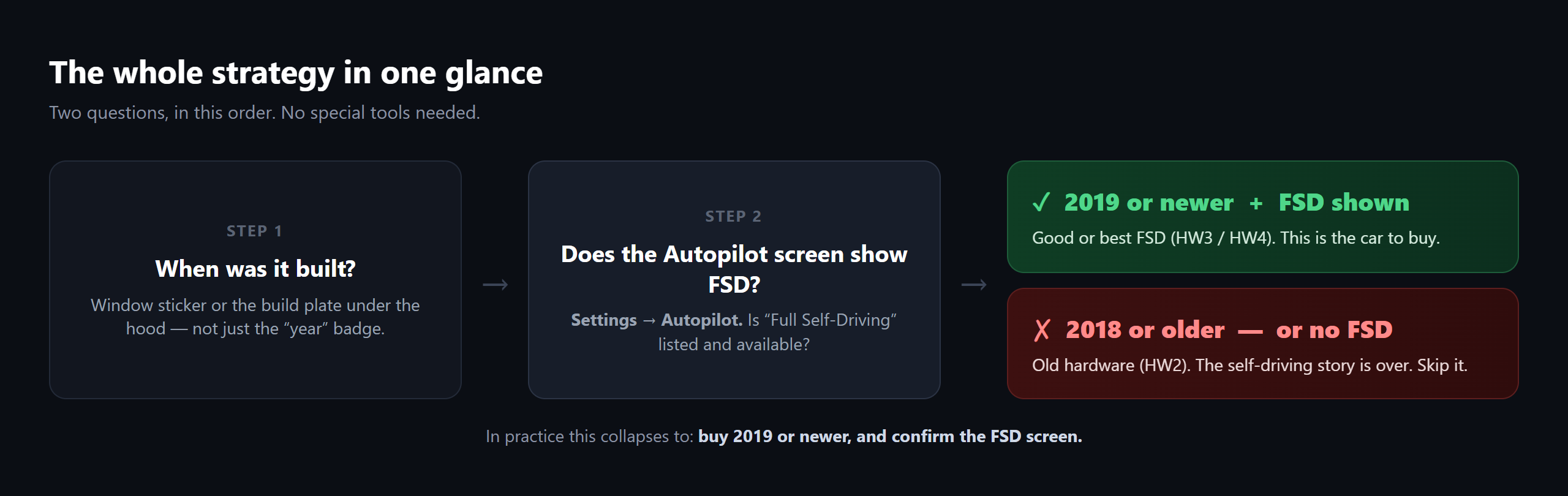
The whole flow, in one glance:
-
Find the exact build date, not just the year. The window sticker (the laminated sheet usually kept in the glovebox) and the build plate (open the front trunk and look under the hood) both show the actual build date. For a trade, this is in your hands. For auction, it's the first thing to ask the consignor to photograph. This is the single most reliable signal: a mid-2019-or-later build date is your friend.
-
Look at the front cameras. The older HW2/HW2.5 cameras are small and thin. The HW3 and HW4 cameras are clearly bigger and boxier, especially the two on the front fenders. A car with the chunkier, larger camera lenses is on the newer hardware.
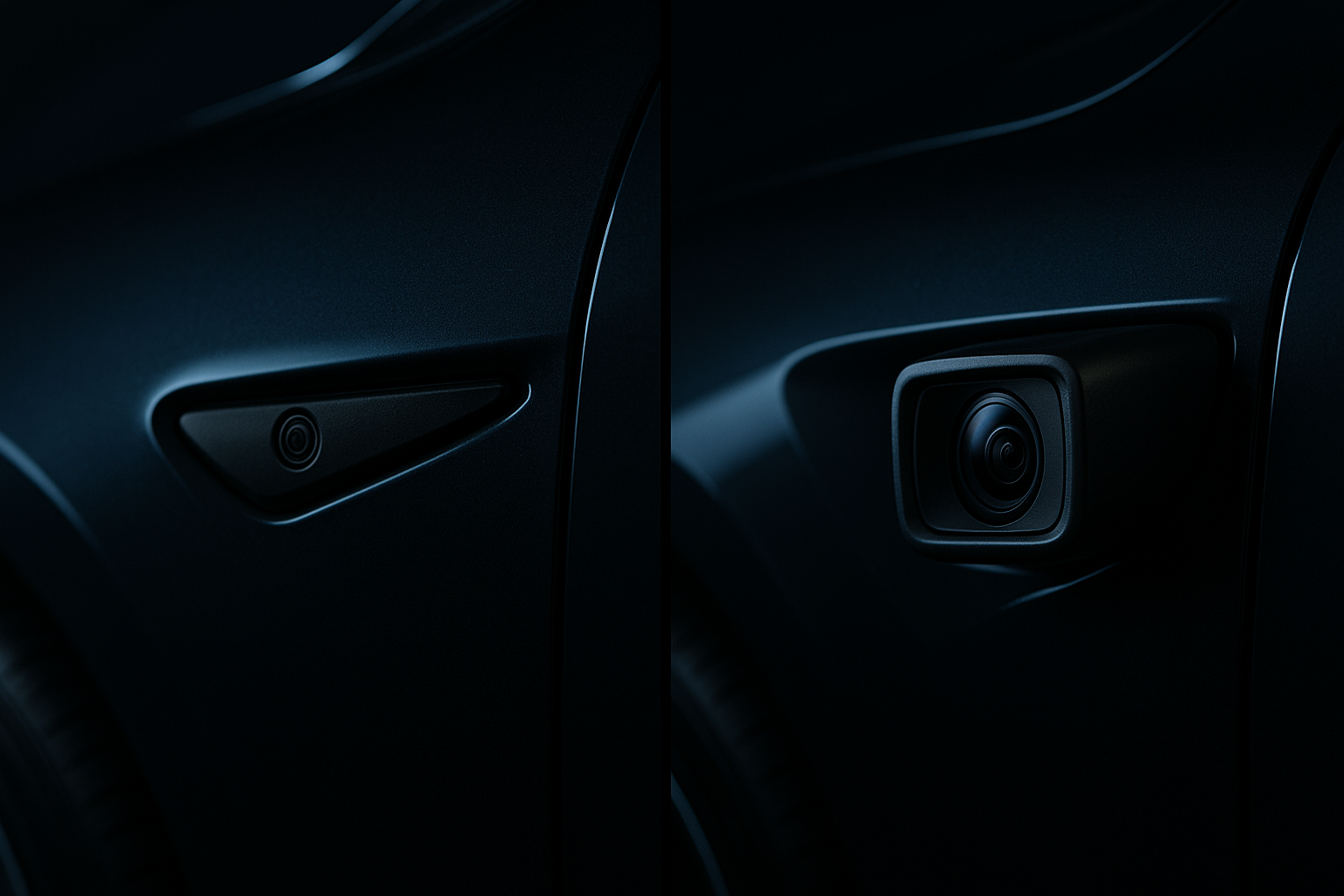
Left: the old, thin HW2 lens. Right: the bigger, boxier HW3/HW4 lens. If the fender camera looks like the left one, that's the unit that's worth less.
-
On the touchscreen, go to
Settings → Software. Note the version. A modern car is running a recent software build; this is a quick sanity check that the car's software stack is current. -
On the touchscreen, go to
Settings → Autopilot. This is the one that matters.- If it shows FSD (Full Self-Driving) as available or already running → good hardware. This is HW3 or HW4.
- If it only shows standard Autopilot / Enhanced Autopilot, or FSD is grayed out or missing → old HW2 hardware. That's the car you price down or walk from.
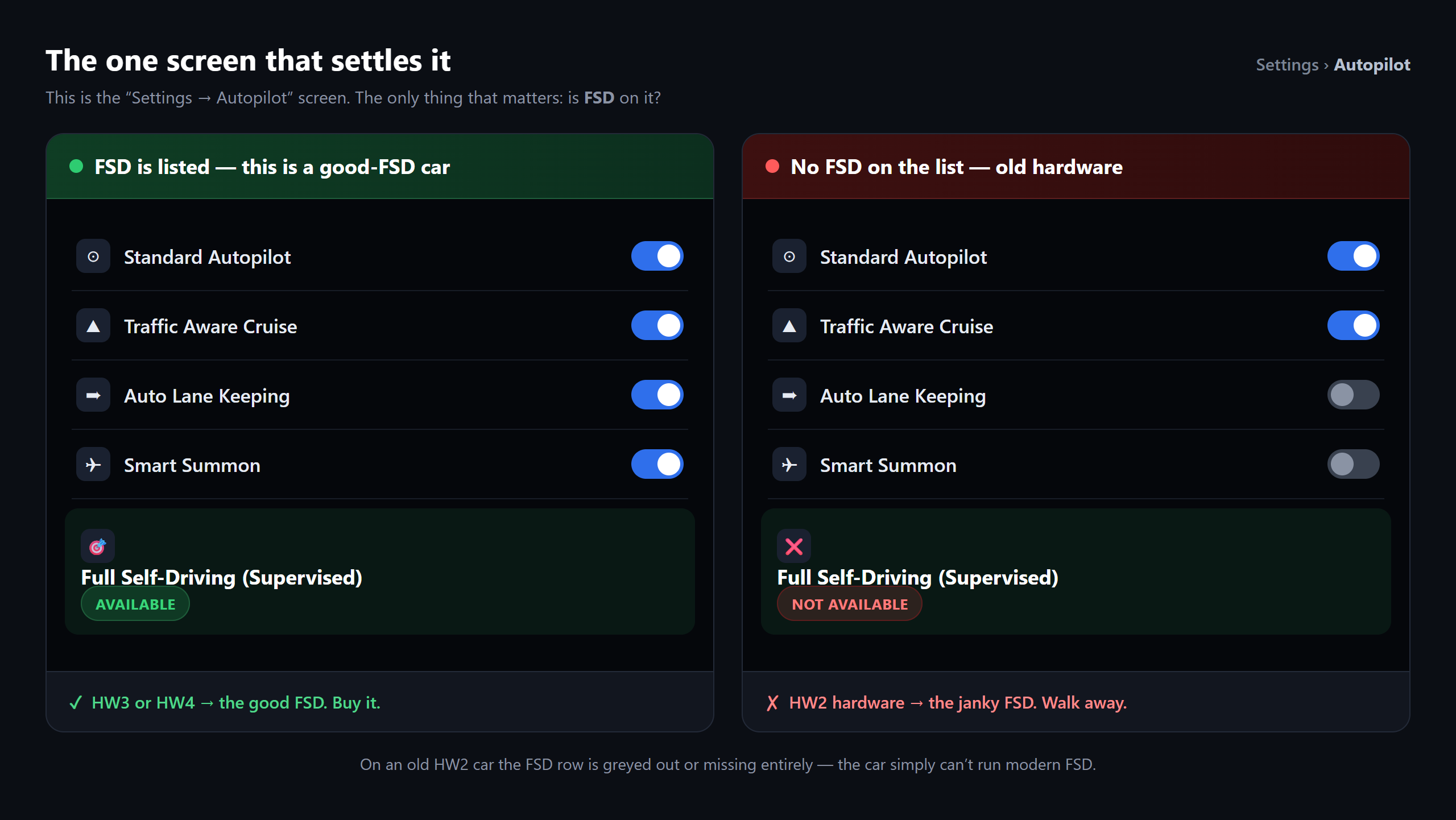
This is the screen to photograph or screenshot on the spot. For a trade, the customer's own phone taking it is your best evidence. At auction, send the seller the exact path and ask for a photo before you bid. If "Full Self-Driving" is on the list and available, it's the good hardware. If it's greyed out or missing, it's old hardware.
-
For a trade, take a short FSD drive. On a good car, FSD handles highway and city streets with real confidence. On an HW2 car, even where a degraded FSD is offered, it feels a step behind — lane-keeping is rougher and it hesitates more. A few minutes behind the wheel confirms what the screens told you, and it's also the moment you can explain the number to the customer.
Pass = build date of mid-2019 or later, and the Autopilot screen shows FSD. That's a good-FSD car. Fail = a pre-mid-2019 build date, or the Autopilot screen doesn't show FSD. That's old hardware, and it won't catch up.
How to price it: trade-in vs. auction
The hardware answer changes what you should do at each window.
At the trade window. A customer trading in a pre-2019 (HW2) Tesla is, in most cases, going to tell you it "still has Autopilot" and assume it's worth the same as a 2019 car. It isn't. The good-FSD cars hold value; the janky ones are the ones losing it faster. So the move is to run the five-minute check in front of them, show them the Autopilot screen, and explain plainly that the older hardware can't run modern FSD — which is exactly why your offer reflects it. You're not lowballing; you're being transparent about a permanent, non-fixable limit. A customer who sees the screen and understands the limit accepts a fair number. A customer who doesn't get the explanation comes back angry. The check is your friend at the trade window.
At the auction. You don't have the car in hand and you don't have the customer to explain it to. So the discipline is different: don't bid blind. Before you commit, get the build date and a photo of the Autopilot screen from the consignor. If the listing is a 2018 Model 3 and you can't get a clean answer on the hardware, treat it as the worst case (HW2.5) and bid accordingly — or skip it. The cost of a five-minute back-and-forth with the seller is nothing compared to the cost of winning a lot that's HW2.5 and pricing it as HW3.
Why the good-FSD cars are worth more (the margin is real)
It can look like you're overpaying for a few model years of badge when the difference is "2019" versus "2018." It isn't. The gap is real, and here's why the newer-hardware cars carry a higher acquisition cost and a higher sale price.
1. The hardware is a permanent ceiling on the car's most valuable feature. FSD software improves on a regular schedule. An HW3 or HW4 car keeps receiving all of those improvements for years to come. An HW2 car mostly stopped receiving them. You're not just buying how the car drives today — you're buying how it will keep driving for the next several years, and the old hardware has almost none of that runway left. That's margin you can protect on the front end and still bank on the back end.
2. It can't be fixed later. This is the part that locks the value gap in. No shop can retrofit HW4 into a 2017 Model S. The hardware decision was made at the factory and can't be changed after the fact, so the value difference between generations is permanent. That's exactly why the discount on an older car is where it is — the market is pricing in a self-driving future that's already over for that unit.
3. FSD is a subscription, and it only pays off on new hardware. Owners pay Tesla for FSD specifically because on HW3 and HW4 it actually drives the car in a genuinely useful way. The same subscription on an HW2 car delivers a weak product. The car that can deliver the full product is the one with the higher resale value — and the one you can market hardest.
4. Resale follows the technology curve. You can watch it happen across every model: the old-hardware cars have been losing value faster than the newer-hardware cars for the same reason your customers are already seeing it — the self-driving story is different for each generation. The HW3 cars have held their value well, and the HW4 cars should hold it even better, because they were built for the next wave of updates and will stay relevant longer.
5. Better cameras and more compute mean longevity. When FSD gets meaningfully smarter — closer to the hands-free capability people are waiting for — it will arrive on the newest hardware first and run most reliably there. The unit you buy with the best hardware is also the last one you'll want to turn around quickly, which is precisely why it earns a higher number now.
Cheat sheet
Pin this at the trade desk and the auction terminal.
| Unit | Hardware | FSD | How to handle it |
|---|---|---|---|
| Pre-2018 Model S / X | HW1 / HW2 | No / janky | Price down hard; run the check to show the customer why |
| 2016–2018 Model S / X | HW2 / HW2.5 | Janky | Price down; the janky FSD is the whole reason the number is lower |
| 2018 Model 3 | HW2.5 or HW3 | Coin flip | Get the build date + Autopilot screen before you price or bid. Worst-case until proven otherwise |
| 2019–2023 Model 3 / Y / S / X | HW3 | Good | The value sweet spot — pay up, sell up |
| 2024+ Model 3, 2025+ Model Y | HW4 | Best | The premium car; the margin is justified |
| Any Cybertruck | HW4 | Best | The premium car |
The final rule: if the unit is a 2019 build or newer and the Settings → Autopilot screen shows FSD, it's a good-FSD car — pay for it and sell it as one. Everything 2018 or older gets the five-minute check before you write a number, and a 2018 Model 3 gets treated as worst-case until the build date and the screen prove otherwise.
Hardware generations (HW1 through HW4) don't change, so the year cutoffs above stay a reliable test long after the software versions move on. If a unit ever lands in a genuine gray area, the five-minute check settles it — and at auction, it settles it before you bid, which is the whole point.
Get Our Answers in Your Google Results
Add Savvy Dealer as a preferred source and Google highlights our articles with a Preferred badge in AI Overviews, AI Mode, and Top Stories. One click, then check the box next to savvydealer.com.
Ready to Transform Your Dealership's Marketing?
Schedule a free demo to see how Savvy Dealer can help you sell more cars.