
Carvana Is a New Car Dealer Now. Small Markets Are Finding Out the Hard Way.
Last month the number two seller of new CDJR vehicles in one small Pennsylvania market was a Carvana store in Casa Grande, Arizona. 29 new units into a 50 mile radius from 2,000 miles away, more than the local franchise store sold at home. Here is what the sales data shows and what franchise dealers should do about it.
Nick leads sales at Savvy Dealer and brings deep automotive operations experience as a former vAuto performance manager.
Want to Learn More?
Book a quick demo to see these strategies in action.
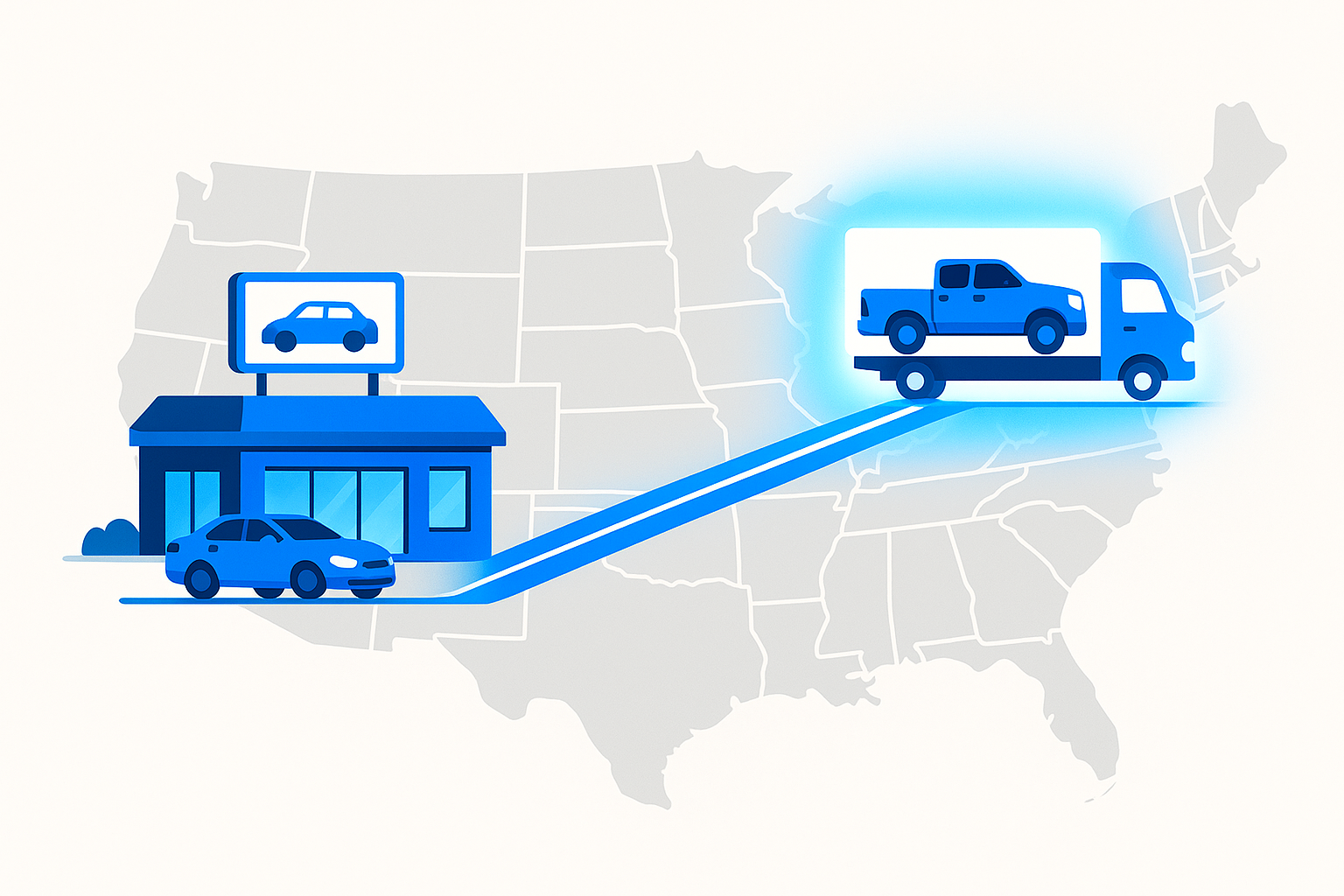
Last month, the second biggest seller of new Chrysler Dodge Jeep Ram vehicles in one small Pennsylvania market was not a Pennsylvania dealer. It was Carvana's store in Casa Grande, Arizona. Twenty-nine new vehicles reported sold to buyers within 50 miles of the local CDJR franchise, from a rooftop more than 2,000 miles away. The local franchise store sold 24 in its own backyard that month.
Two years ago that sentence would have been impossible. Carvana sold used cars, your franchise covered new, and the worst they could do was skim your used truck buyers. That era is over, and the factory's own sales reporting data shows what replaced it.
How is Carvana selling new cars?
Carvana entered new-car retail in February 2025 by buying a Chrysler Dodge Jeep Ram store in Casa Grande, Arizona. Since then it has bought six more, and now owns seven Stellantis franchises across Dallas, San Diego, Sacramento, Atlanta, Cleveland, and Boston. Stellantis approved every one of those buy-sells.
This is not a pilot program anymore. The Casa Grande store alone moved more than 700 new vehicles in a single month, by Stellantis' own figures reported by CNBC, and 998 new units in June 2026 according to a special report from Car Dealership Guy. And Carvana has been open about the model: they will sell new cars exactly the way they sell used ones. Online, delivered to the driveway, with the whole country as the addressable market.
That last part is the piece most dealers have not absorbed. A traditional buy-sell swaps one local operator for another. This one swapped a local operator for a national e-commerce machine that happens to hold a franchise.
What does the data show in a small market?
We pulled the RDR-based sales reporting for one small-market Pennsylvania CDJR store, the same data the factory uses, covering every new vehicle reported sold to a buyer within 50 miles. Here is what July 2026 looked like: 693 new CDJR vehicles sold into that radius, split across 99 selling dealers. The number one seller was the region's biggest local auto mall with 40. Number two was Carvana Chrysler Dodge Jeep Ram of Casa Grande, Arizona, with 29. The store that actually holds the franchise for this market sold 24.
Read that again. In this market's own factory sales data, a single Carvana rooftop in the Arizona desert outsold the hometown franchise dealer, and only one of the 98 other selling dealers beat it. The 29 units were not one fluke model either: Ram 1500s, Wranglers, Gladiators, Compasses, Cherokees, Durangos, a Ram 2500.
The trend line is the scarier part. That same Carvana store put 11 new units into this market in February, 2 in June, then 29 in July. Over the trailing twelve months it totals 42, which means most of it happened in the last 60 days. This is what a national e-commerce machine scaling a new business line looks like from inside one small market.
Even the heavy-duty niche tells the story. Buyers in this market bought 279 new Ram 2500s so far this year. Three of those trucks shipped from Texas and Arizona sellers, two of them sold by Carvana. A small store stocks a handful of 2500s in the configurations it can trade for. Carvana lists all of them, everywhere.
The advertising data matches. When we pulled the store's vehicle listing ad auction data, the number one competitor was Carvana. Bigger than any franchise dealer in the county, on the brand this store holds the franchise for. Carvana's national inventory feed and national ad budget follow the shopper into every zip code, whether that zip code has 2 million people or 40,000.
To be clear about what we can and cannot prove: nobody can trace one specific truck sale to one specific ad. What the data shows is the shelf. Vehicle listing ads are where a serious shopper meets actual inventory with actual prices, and in this market Carvana is the biggest bidder on that shelf. Twenty-nine deliveries later, you can draw your own conclusion about whether that presence is working.
Are they winning on price?
We checked, because if the answer were "Carvana undercuts local stores by ten grand," none of the advertising advice would matter. It isn't.
On the day we compared, Carvana advertised a new 2026 Ram 1500 Big Horn crew cab at $50,635 against a $65,000 MSRP. The local franchise store had a nearly identical Big Horn, $65,635 MSRP, that netted out around $54,400 after its advertised dealer discount, factory incentive, and doc fee. The gap on a like-for-like truck was roughly $3,700, call it 7 percent.
Here is the part dealers get wrong about a gap that size. The old instinct says $3,700 is negotiable: get the buyer in the lane, put a strong number on the trade, close the difference at the desk. That playbook assumes you get the at-bat. You don't. Anyone in their right mind saves the $3,700 from the couch, and the truck shows up in their driveway three days later. They never call you, never email you, never set foot in your store. The first time you learn the deal existed is when the sales data shows a truck delivered into your zip code. A price gap you never get the chance to negotiate is just a lost sale.
Then it compounds, because of how the price shows up. Carvana's shelf shows one clean number. The typical dealer site shows MSRP, then an asterisked stack of conditional discounts the shopper has to do math on, plus a doc fee at the end. And in a vehicle listing ad there is no asterisk: whatever price your inventory feed sends is the number standing next to Carvana's. If your feed sends MSRP while your actual selling price is $11,000 lower, the shopper sees a $15,000 gap that does not exist, and the click, and the truck, go to Arizona. Send the real price.
Why doesn't your PMA protect you?
Your franchise comes with a Primary Market Area, and the factory grades your sales efficiency inside it. It feels like territory. In practice, a PMA only measures you, and nothing in it stops another franchised dealer from selling to buyers who live there.
Any franchised dealer has always been able to sell to an out-of-market buyer. What changed is scale and intent. Carvana operates as a national retailer whose selling model has no geography at all, holding franchises the factory approved, listing every configuration of Ram 2500 in America against your market.
Small markets may actually have it worst. A small store stocks a handful of heavy-duty trucks at a time, in the configurations the dealer principal thinks will move. Carvana lists all of them, everywhere, and delivers. Call it targeting or call it scale, the result at the store level is identical: your PMA obligates you and protects nothing.
We are not the only ones looking at this. Car Dealership Guy published a special report on the same model, reported across 40 sources, laying out the concerns franchise dealers have raised about how it operates inside the franchise system. Worth reading alongside your own market's numbers.
This is the kind of check we run for dealers: show you who is actually selling into your market, then build the plan to protect it. Get a market protection audit.
What happens if Carvana adds more brands?
Today this is a Stellantis story. Seven franchises, one OEM, concentrated in CDJR product. But the mechanics are not brand-specific. Every OEM that lets Carvana into its network repeats this in every market at once, on day one, with no ramp-up period. The Casa Grande store's 998-unit month is the sales pitch Carvana takes to the next manufacturer.
Dealers spent the last decade watching OEMs flirt with direct sales and agency models. This is a different door into the same room. The factory does not need to sell direct if a national e-commerce retailer inside the franchise system will do it for them.
What should dealers do this week?
Run your own vehicle listing ads, from your own account, on your own feed. This is the whole ballgame. Carvana did not buy a billboard in Pennsylvania. They show up on the shopping shelf every time a local buyer searches, with real inventory and real prices, funded by a national budget. If your VLA presence is whatever a third party marketplace or a vendor's shared feed decides to give you, then your shelf space is rented, and it is rented from companies whose incentives are not yours. Your inventory, your feed, your ad account, your data. That is the moat, and nobody builds it for you.
Pull your vehicle listing ad auction data. Most dealers have never looked at who they actually bid against. If Carvana is your number one VLA competitor, you are already in this fight whether you knew it or not. Your agency can pull this in minutes. If they can't, that tells you something too.
Get real sales reporting for your market. RDR-based sales intelligence shows you every new vehicle reported sold in your market and who sold it, often same-day. The dealer in this story only knew Carvana went from 2 units to 29 in a month because the data showed it. Without it, those deals are invisible. You just sell fewer vehicles and never know why.
Fix the reasons a buyer goes around you. The buyers who bought from a store 2,000 miles away did it for selection, price transparency, or convenience. Every one of those is fixable at the store level: list your full inventory with real prices, merchandise the configurations you can trade for, and make the online path to a deal shorter than a cross-country shipping window.
The dealers who get hurt worst by this will be the ones who never saw it in their data. The ones who compete with it will be the ones watching the same numbers Carvana is.
FAQ
Is Carvana really a franchised new car dealer? Yes. Carvana has purchased seven Chrysler Dodge Jeep Ram franchises since February 2025, in Arizona, Texas, California, Georgia, Ohio, and Massachusetts. Stellantis approved each acquisition, per Automotive News.
Can Carvana sell a new car to a buyer in another state? Generally yes. Franchised dealers can sell to out-of-market buyers, and Carvana's model is built on nationwide online sales with delivery. State rules vary on titling and delivery mechanics, but distance selling of new vehicles by a franchised dealer is established practice.
Does my PMA stop other dealers from selling into my market? No. A Primary Market Area defines where the factory measures your sales performance. It has never prevented another franchised dealer, or Carvana, from selling to buyers who live there.
Are dealers pushing back on this? Yes. A special report from Car Dealership Guy, reported across 40 sources, documents franchise dealers raising concerns in six areas: website standards, service capacity, sales and allocation, inventory and vehicle storage, PMA and market reach, and the economics of the model. Stellantis, which approved the acquisitions, told Car Dealership Guy it "remains committed to treating dealers fairly, consistently, and in accordance with our Dealer Sales and Service Agreements, established policies and procedures, and applicable law."
How do I find out if Carvana is competing in my market? Two places: your vehicle listing ad auction insights, which show who you bid against for your own inventory searches, and RDR-based sales reporting, which shows who is actually selling new vehicles into your zip codes.
What are vehicle listing ads and why do they matter here? Vehicle listing ads (VLAs) are the inventory-based ads on Google's shopping surfaces that show a real vehicle, price, and dealer when someone searches for a model. They are where high-intent buyers meet actual inventory. A dealer whose VLA presence runs through a third party marketplace or a shared vendor feed is renting that shelf; a dealer running VLAs from their own account and feed owns it.
If you want to know who is actually selling into your market and what to do about it, book a market protection audit and we'll show you the gap and the plan to close it. Pulling it is the easy part. Acting on it before the next three trucks ship in is the point.
Get Our Answers in Your Google Results
Add Savvy Dealer as a preferred source and Google highlights our articles with a Preferred badge in AI Overviews, AI Mode, and Top Stories. One click, then check the box next to savvydealer.com.
Ready to Transform Your Dealership's Marketing?
Schedule a free demo to see how Savvy Dealer can help you sell more cars.