
Google's New 'Intelligent Search Box' and Why Most Dealers Are Reacting to It Backwards
Everyone's panicking about Google's new AI search. But when we ran the queries that actually drive showroom traffic, the SERP looked the same as it did ten years ago. Here's where AI is actually hurting dealerships, and why most are reacting to it backwards.
Nick leads sales at Savvy Dealer and brings deep automotive operations experience as a former vAuto performance manager.
Want to Learn More?
Book a quick demo to see these strategies in action.
If you've spent any time on LinkedIn this week, you've probably seen the headlines: Google just rolled out its biggest search redesign in 25 years. "AI is going to kill SEO." "The death of the click is here." "Dealer websites are doomed."
We're going to tell you something different.
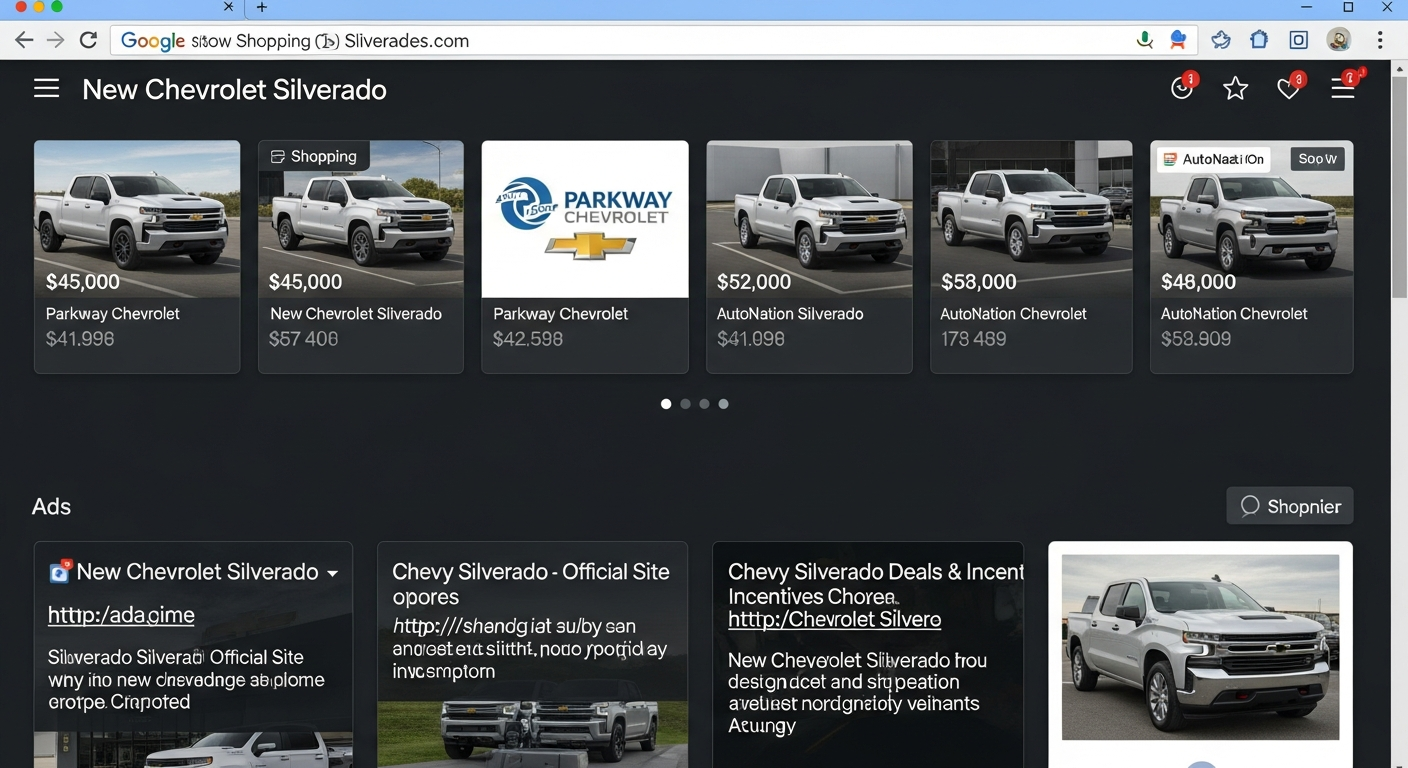
The day after Google's announcement, we opened a browser and searched "Silverado for sale near me," the kind of query a real customer types when they're ready to buy a truck.
Same search results we've been looking at for the last ten years. Sponsored ads at the top. Map pack with the local dealers. Organic listings underneath. Zero AI takeover. Nothing meaningfully different.
That's the contrarian takeaway nobody in the SEO panic crowd wants to say out loud: AI is not coming for the part of search that actually drives showroom visits. At least not yet.
But it IS coming for a different part of search, a part most dealerships have ignored for years. And if you're a GM, that's the conversation you should be having with your marketing team right now, not the one about whether your VDPs are going to stop ranking.
Here's what's actually happening, and what we'd tell you to do about it if we ran your store.
What the Headlines Are Missing
Google makes money, billions of dollars a year, from one specific thing. When somebody searches a buying query, they click a sponsored ad. That's the cash cow. That's the engine of Google.
When AI conflicts with the cash cow, Google protects the cash cow.
Try it yourself. Open a new browser tab and search:
- "Silverado for sale near me"
- "Ford dealer Tampa"
- "Used Tahoe under $40k"
- "F-150 lease specials"
You'll see exactly what you've been seeing for years. Ads first. Map pack second. Dealer listings third. Maybe a small AI summary off to the side, but nothing that takes you out of the picture.
This isn't an accident. It's the part of search Google has the most to lose by disrupting. And as long as you and the dealer down the street are still paying for ads on those queries, Google has every reason to leave that experience alone.
Where AI Actually IS Eating Dealer Visibility
So if AI isn't coming for your VDP traffic, where is it actually showing up?
In the research phase. The part of the funnel that happens long before a customer ever types "Silverado near me."
These are the queries:
- "What's the best midsize SUV for a family of five?"
- "Most reliable used pickup under $30,000?"
- "Is a hybrid worth it over gas in 2026?"
- "Should I buy or lease right now?"
- "What does Tesla financing actually cost?"
When a customer asks one of those questions today, they don't get a list of links. They get an AI answer that pulls from blogs, news sites, Reddit threads, and, very rarely, a dealership.
That's the part of the funnel that's being rewritten. And here's the question for you as a GM: where does your dealership show up in that conversation?
For most stores, the honest answer is: nowhere.
Why That Matters More Than You Think
Think about how your customers actually decide where to buy.
By the time somebody searches "Chevy dealer near me," they've already made the big decisions:
- They want a Chevy.
- They've narrowed it down to two or three dealerships they've already heard of.
The transactional search is the last step in a long journey. The work that actually decides whether you make their shortlist happens way upstream, in the research phase.
That research used to happen on a hundred different sites: KBB, Edmunds, Cars.com, OEM pages, YouTube reviews, forums. Customers stitched the picture together over weeks.
Now AI is collapsing all of that into a single answer. Whatever Gemini, ChatGPT, or Perplexity says when somebody asks "what's the most reliable used truck under $30k" is increasingly the answer that customer walks away believing.
If your dealership isn't part of how that question gets answered, you're already losing shoppers before they ever search inventory. By the time they type "Silverado for sale near me," it's usually too late to change which two or three stores they're considering.
What Most Dealers Are Doing About It (Wrong)
When the AI search panic kicked off about 18 months ago, vendors started selling the wrong solutions to the wrong problem. Add more inventory schema. Stack more long-tail city-and-model pages. Buy AI bot whitelisting tools that promise to keep crawlers coming. Pay more for traditional SEO to "protect" your VDP rankings.
None of that is necessarily wrong. But it's all aimed at protecting traffic AI isn't actually taking. It's defending the part of the funnel that isn't being disrupted while completely ignoring the part that is.
Meanwhile, the actual research-phase queries, the ones AI is rewriting in real time, keep getting answered by national publications, generic comparison sites, OEM corporate blogs, and Reddit. Almost never by a dealership.
That's the gap. And it's a gap a smart dealership can close.
What We'd Actually Tell You to Do
If we ran your store, we'd tell you four things.
1. Audit your blog the way a customer would.
Pull up your dealership's blog right now. If most of the posts are titled things like "5 Reasons to Love the New Tahoe" or "Why You'll Want a 2025 F-150," those aren't earning you anything. Nobody searches those questions. No AI cites those posts. Kill them or stop publishing them.
2. Write the stuff customers actually ask.
Sit in the showroom for one day and write down every real question a customer asks before they pick a vehicle. "How does the lease math actually work?" "Is the older Highlander reliable?" "What's the real cost difference between CPO and used?" "Is the EV tax credit going to stick around?"
Those are the queries AI is answering. Write the best answer on the internet for each one, locally grounded, transparent, no fluff, and you become the source AI cites. The trade press calls this the shift from SEO to GEO. Same idea. Be the answer, not just a link in a list.
3. Make sure your website can actually be read by AI.
This one is more technical, but you don't have to understand the details. You just have to ask your website vendor one question:
"Can a machine read every page of our site in under one second, and is our pricing, inventory, and incentive data formatted in a way Gemini can pull cleanly?"
If they hem and haw, that's your answer. We broke this down in Lightning-Fast Dealer Websites and How AI Search Engines Rank Your Dealership, both worth forwarding to whoever runs your site.
4. Don't pull back on paid search.
This is the one most GMs are getting wrong right now. The transactional SERP is still intact. Your local PPC, inventory ads, and paid social still work, possibly better than ever, because the customers AI sends through to that part of the funnel are more researched and more decisive.
Don't cut your ad budget over an AI panic. The dealers who win the next two years are going to be the ones who own both ends: the research conversation and the transactional click.
The Bottom Line
Google's biggest search overhaul in 25 years didn't kill dealer SEO. It didn't kill VDP traffic. It didn't kill your website.
What it did was widen the gap between two kinds of dealerships:
The ones still fighting only for the click, and the ones starting to fight for the citation.
The dealerships that win the next decade are the ones that show up in the AI conversation before a customer ever types your name. The ones that get cited when a customer asks a question, not the ones with the prettiest landing page. We saw the early shape of this when Google's AI browser experiments first surfaced; the future just moved closer.
Don't react to the AI panic. React to the actual opportunity it's creating.
Want a no-jargon look at how your dealership shows up in AI-driven search right now? At Savvy Dealer, we build the SEO, websites, paid media, and research-phase content engines that work the way modern search actually works. Request a free audit and we'll show you exactly where you're invisible, and what it would take to fix it.
Get Our Answers in Your Google Results
Add Savvy Dealer as a preferred source and Google highlights our articles with a Preferred badge in AI Overviews, AI Mode, and Top Stories. One click, then check the box next to savvydealer.com.
Ready to Transform Your Dealership's Marketing?
Schedule a free demo to see how Savvy Dealer can help you sell more cars.